I’ve noticed something interesting while helping friends rethink their backyards. Almost everyone thinks they need a taller fence. But most of the time, the real problem isn’t the fence at all. It’s the sightline. The angle where a neighbor’s kitchen window, second-story bedroom, or deck suddenly has a perfect view of your patio.
I’ve walked into plenty of backyards where everything looked nice on paper. A fence, a patio set, maybe a few shrubs. Yet the space still felt strangely exposed.
What actually works, in my experience, is something designers call layered privacy. Instead of relying on one big barrier, you combine plants, screens, and structures so the eye naturally stops before it reaches your seating area.
When you get this balance right, the yard still feels open and breathable. It just stops feeling like you’re on display.
First Identify Where Neighbors Can See Into Your Yard
This is the first thing I always look at when stepping into a backyard.
Before adding anything, I simply stand where people usually sit. A lounge chair, a dining table, sometimes the edge of the patio. Then I look around and ask a simple question: where exactly can someone see us from?
Most backyards have only a few real exposure points.
- Side fences between houses
- Second-story windows
- Corner lots with diagonal views
- Decks or balconies looking down
Once you notice these angles, the solution becomes surprisingly obvious. Instead of surrounding the entire yard with barriers, you only block the views that actually matter.
Many landscape designers approach privacy this way because combining several softer layers tends to feel more natural than one solid wall around the property.
Tall Plants That Create Natural Backyard Privacy

If I had to choose one privacy solution that almost always works, it would be plants.
A dense hedge or a row of tall ornamental grasses can quietly block sightlines while making the yard feel greener and calmer.
I especially like using plants where fences feel too rigid. The foliage softens everything. Suddenly the boundary stops looking like a barrier and starts looking like part of the garden.
Climbing vines are another favorite trick of mine. When they grow along a trellis or fence, they create a vertical green layer that filters views without feeling heavy or closed.
If your outdoor space is compact, I often recommend using tall plants in planters instead of planting directly into the ground. That approach works especially well in tighter spaces like the ones I talk about in my guide to small backyard privacy ideas.
Freestanding Privacy Screens That Don’t Feel Permanent

Sometimes plants need time to grow, and not everyone wants to wait two seasons for privacy. That’s when I start looking at outdoor screens.
I like them because they solve the problem immediately without making the yard feel like a construction project.
Instead of lining the entire fence, I usually place screens exactly where people sit or relax.
- Behind an outdoor dining table
- Next to a hot tub or lounge chair
- Along a fence that faces a neighbor’s window
Slatted wood panels are one of my favorite options. They interrupt direct sightlines but still allow light and airflow to pass through.
And if you’re patient, they become even nicer over time once climbing plants start weaving through the gaps.
Pergolas and Overhead Structures for Second-Story Privacy

The trickiest privacy problem usually comes from above. If a neighbor’s second floor overlooks your yard, no fence in the world will fix that.
This is where I often introduce overhead structure.
A pergola, a simple canopy frame, or even a shade sail can break the vertical sightline coming from upstairs windows.
What I love about pergolas is how they change the feeling of a backyard. The moment you add beams overhead, the space suddenly feels like an outdoor room rather than an open stage.
Even partial coverage makes people feel more relaxed because the view downward is interrupted.
Planters That Work Like Movable Walls

This is a trick I borrow constantly from cafés and small boutique hotels.
Large planters can act like soft, movable walls.
When I group tall containers around a seating area, they create just enough enclosure to block nearby views without making the yard feel boxed in.
The best part is flexibility. If you rearrange furniture or redesign the yard later, the privacy moves with you.
It’s a small change that can make a backyard feel much more intentional.
Budget-Friendly Privacy Fixes That Work Immediately
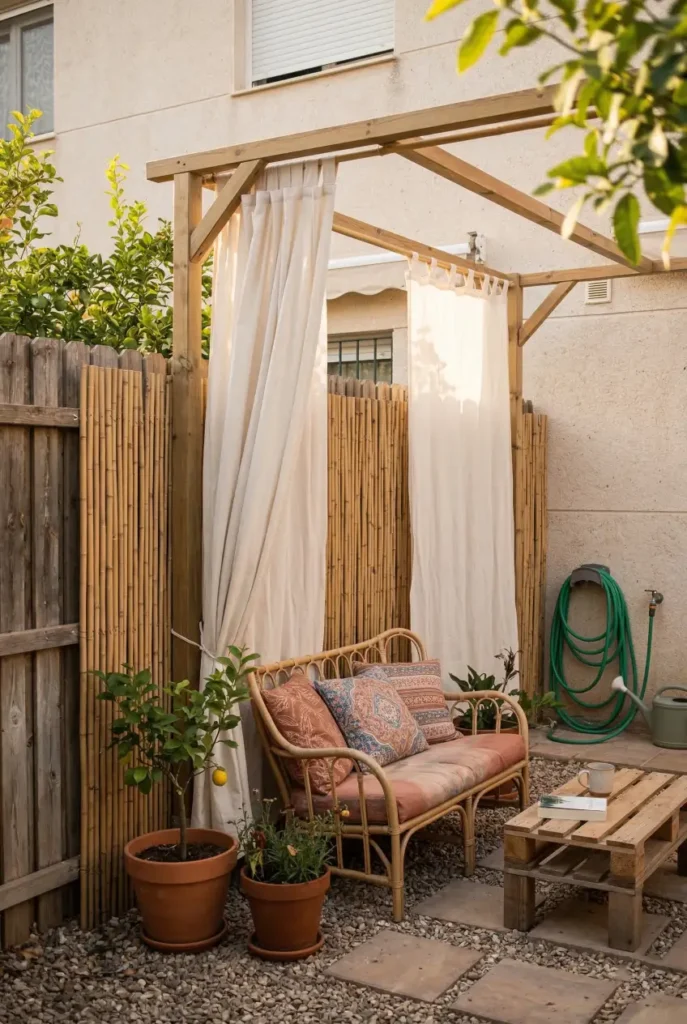
Not every privacy upgrade needs to involve landscaping crews or major construction.
Some of the simplest fixes I’ve used are also the most effective.
- Bamboo panels attached to an existing fence
- Outdoor curtains on a pergola frame
- Trellises with climbing vines
- Tall grasses planted in narrow beds
These ideas work especially well when someone wants to test a layout before committing to permanent changes.
If you’re redesigning the entire backyard but still trying to stay practical about costs, you might also enjoy some of the ideas in my guide to backyard landscaping ideas on a budget.
The Privacy Mistake That Makes Yards Feel Closed Off
The biggest mistake I see is trying to solve everything with a single tall barrier.
Yes, a solid fence blocks views. But it also removes depth, airflow, and visual softness.
The most comfortable backyards almost always use several layers instead.
- A fence for basic separation
- Plants to soften the boundary
- A pergola or screen near seating areas
- Planters to block specific angles
When those elements work together, the yard still feels open. It just stops feeling exposed.
A Backyard Should Feel Like a Retreat, Not a Barrier
To me, backyard privacy has never been about hiding from neighbors.
It’s about creating a space where you can drink your morning coffee, read a book, or have friends over without feeling like someone might be watching from the kitchen window next door. Once you start thinking in layers instead of walls, everything becomes easier.
Sometimes the change that makes the biggest difference is simply one tall plant, one screen, or one pergola placed exactly where the eye used to travel.
And suddenly, the whole backyard feels calmer.