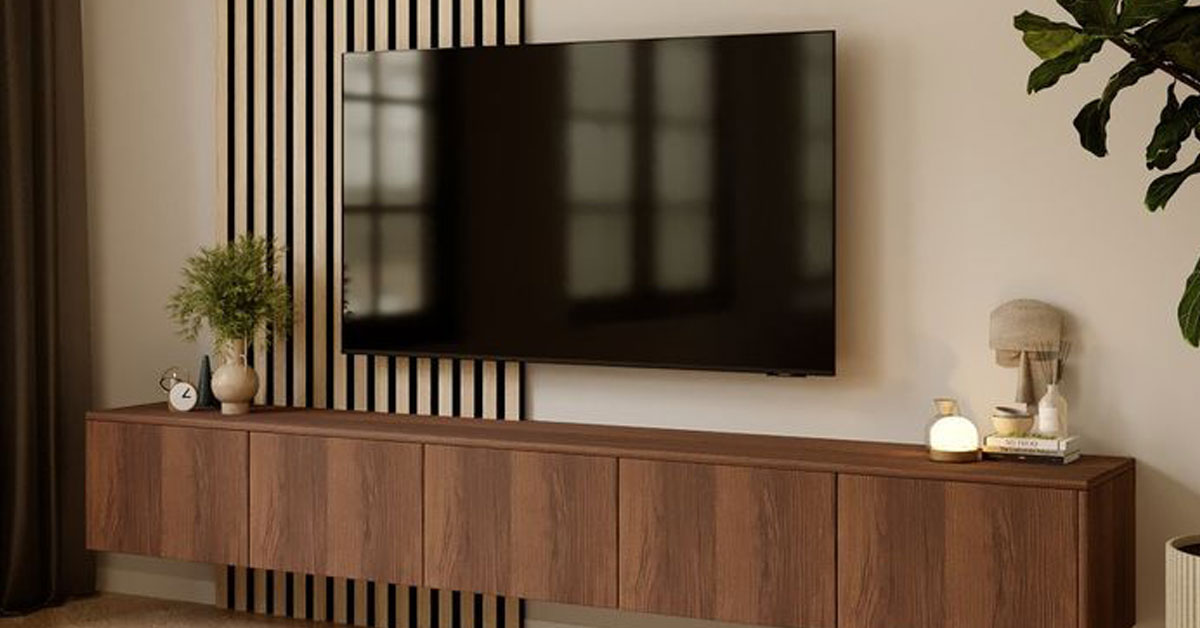
You bought the nice sofa. You styled the coffee table with the oversized book. You added the rug. But when you sit down, the room still feels… unfinished. Like a college apartment with better furniture.
The problem isn’t your decor. It’s the “Black Hole.”
We treat televisions as invisible appliances, assuming they don’t count towards the design of the room. But a 65-inch rectangle of glossy black plastic is the biggest visual element in your space. If you stick it on a plain white wall without a plan, it sucks the energy right out of the room. I see two specific mistakes over and over that make expensive homes look cheap. Let’s fix them. It costs about $40.
Mistake #1: The “Floating Island” Effect
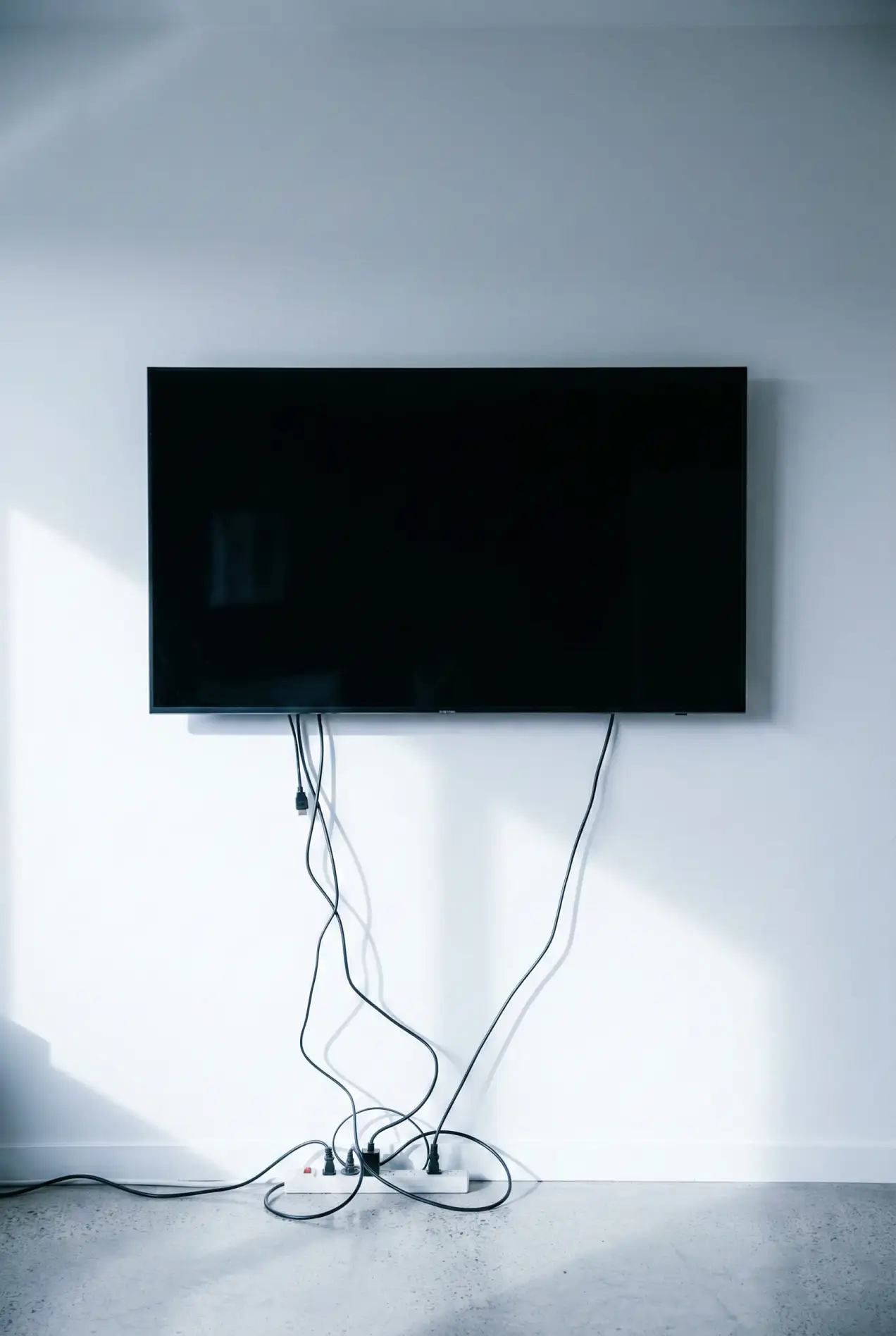
This is the most common offender. You mount a stark black TV in the middle of a massive, empty white wall. No shelves. No art. Just the box.
Designers call this “high contrast anxiety.” Your eye is naturally drawn to the point of highest contrast. In a soft, neutral room, that black box screams for attention. It looks accidental. It looks like you just moved in and haven’t finished unpacking.
The Fix: The Camouflage Wall.
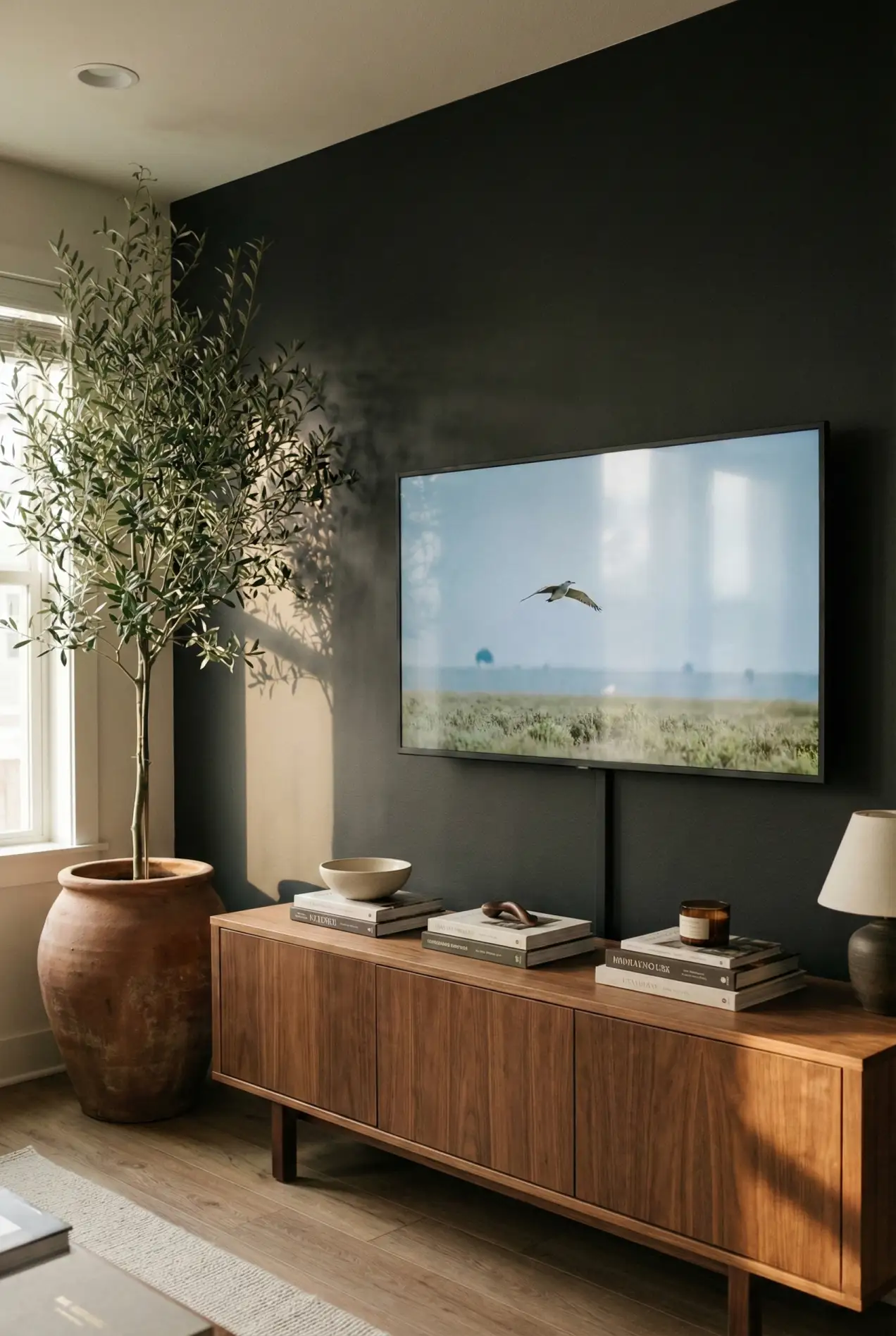
You don’t need custom carpentry. You need a quart of dark paint. By painting just the wall behind the TV (or an arch shape, if you’re feeling bold) in a deep, light-absorbing shade, you kill the contrast.
Think Iron Ore, Greenblack, or a deep Navy. Use a flat or matte finish-never eggshell. Glossy paint reflects the screen light and ruins the movie experience. Matte paint swallows the light and makes the TV disappear when it’s off.
Mistake #2: The “Neck Breaker” Mount
I blame Pinterest for this one. Somewhere along the line, we decided TVs belong above fireplaces.
Unless you live in a sports bar, your TV is too high. If you have to tilt your chin up even an inch to watch a show, the ergonomics are wrong. But visually, it’s worse. A high TV floats near the ceiling, disconnected from the furniture below. It makes the room feel top-heavy and anxious.
The Rule: The center of the screen should be at eye level when you are seated. That’s usually much lower than you think-about 42 to 45 inches from the floor to the center of the TV.
If you *must* go higher (because of a mantel), you need to trick the eye. Place a darker object or a tall plant next to the TV to bridge the gap between the screen and the floor. But if you can, bring it down. Grounding the TV makes the ceiling feel higher.
The Console Rule
One final check. Look at your media console. Is it shorter than your TV?
If the furniture below the TV is narrower than the screen itself, the setup looks wobbly and cheap. It’s a visual physics fail. Your console should be at least 6–8 inches wider than the TV on both sides. This “anchors” the technology and makes the TV feel like it belongs in the room, rather than dominating it.