The wall above your mounted TV is one of the most stared-at surfaces in your home. You look at it every single night. And for most people, it’s either completely empty or filled with something that doesn’t quite work.
Here’s what actually happens: people either leave it blank because they’re afraid to commit, hang something too small that makes the room look unfinished anyway, or overload it with a gallery wall that fights with the screen. All three are fixable. None of them require a decorator.
This is specifically about the gap between the top of your TV and the ceiling. What belongs there, what doesn’t, and why most advice on this gets it wrong.
Why the Space Above Your TV Feels So Hard to Style
The problem isn’t the space itself. It’s the competition.
A mounted TV is already doing a lot of visual work. It’s large, it’s dark when off, and it has a strong horizontal line at the top that your eye naturally follows. So anything you put above it has to either continue that energy or deliberately counterbalance it. If it does neither, it just looks stuck there.
Most people try to fill the space without first deciding what job they want it to do. That’s where things fall apart.
In practice, there are only four things that space can do for a room: add height, add warmth, add personality, or quietly disappear. Any of those is a valid choice. What doesn’t work is trying to do all four at once.
Option 1: The Floating Shelf (The Most Forgiving Choice)
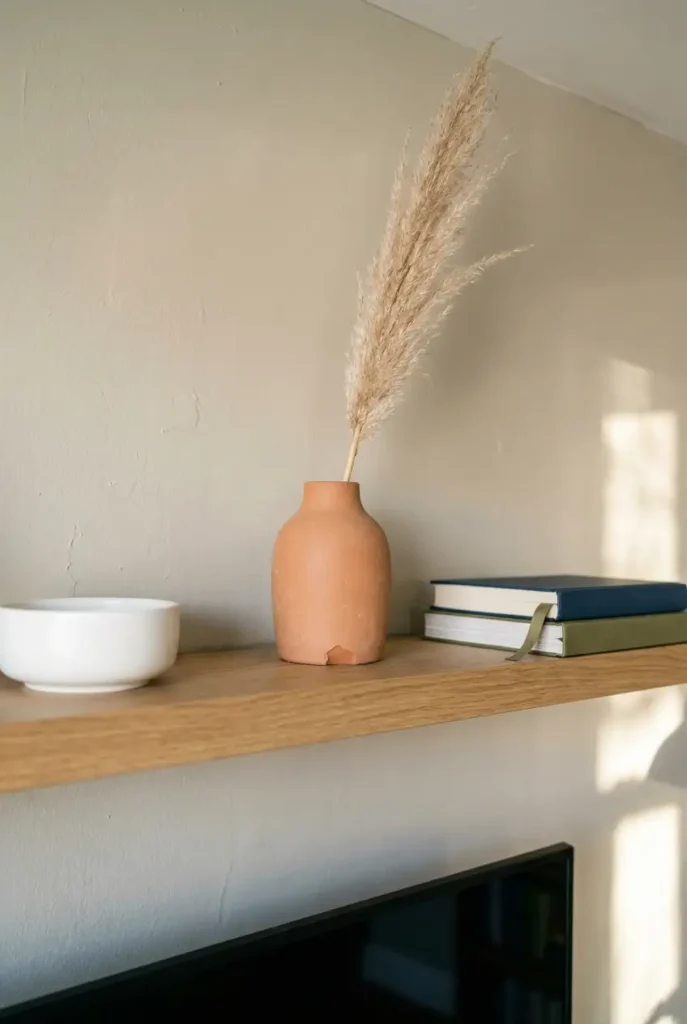
A single floating shelf above the TV is the option I recommend most often. Not because it’s the most impressive, but because it’s the hardest to get wrong.
The shelf creates a dedicated zone. It tells your eye: this is intentional. It also gives you a landing place for objects with real scale, meaning things that can actually be seen from across the room.
What goes on the shelf matters more than the shelf itself. Here’s what works:
- One tall element. A vase, a sculptural object, a potted plant. Something with vertical height that draws the eye upward.
- One or two mid-height objects. Small stacked books, a candle, a low ceramic bowl.
- One trailing or soft element. A small plant with draping leaves, or something that breaks the hard horizontal line of the shelf.
Three to five objects total. Beyond that, it starts feeling crowded rather than curated.
Shelf width matters too. It should be narrower than your TV, roughly 60 to 70 percent of the screen’s width. A shelf wider than the TV competes with it visually. A shelf the exact same width looks like it came in a kit.
Option 2: A Single Piece of Art above TV
Art above a TV can look extraordinary. It can also look like you ran out of wall space and ended up there by accident.
The difference is almost entirely about sizing.
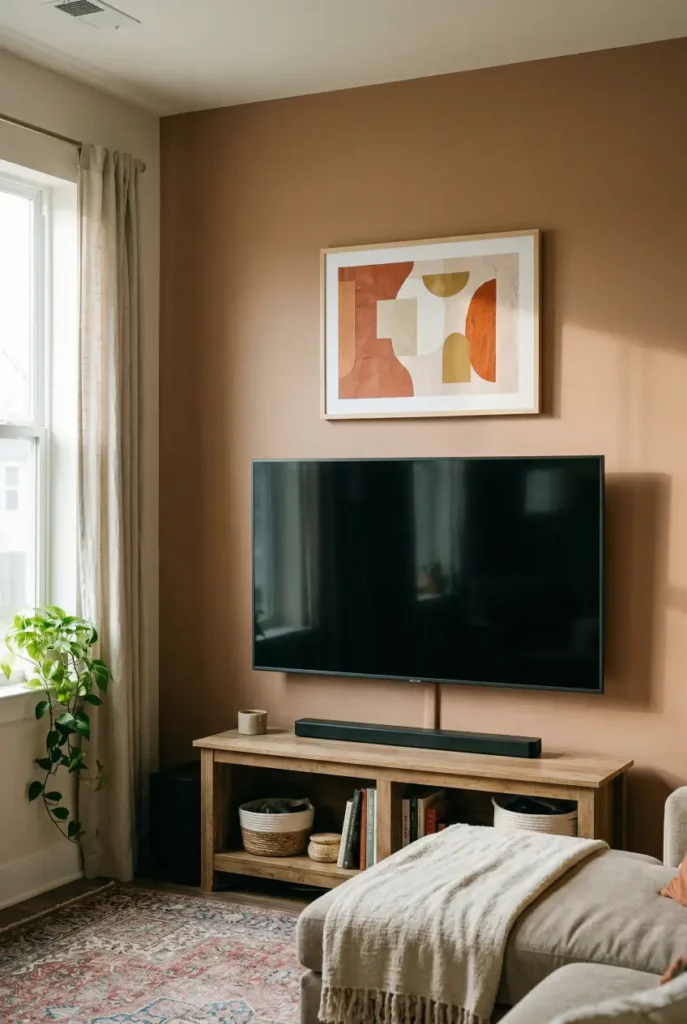
The piece needs to be substantial. Not filling the entire wall, but large enough to register from the sofa. As a general rule, the art should be between 50 and 75 percent of the TV’s width. Anything smaller reads as an afterthought. Anything wider starts competing with the TV for dominance, and during a movie, that visual noise becomes distracting fast.
The gap between the top of the TV and the bottom of the art matters just as much. Too close and they merge into one confusing rectangle. Too far and the art floats, disconnected from everything below it. Aim for 6 to 8 inches of wall showing between the top of the screen and the bottom edge of the frame.
If you’re going with art above the TV, commit to one piece. Not a gallery. Not a grid of four small prints. One piece. The TV is already a focal point, so what you’re doing is adding to it, not competing with it.
Option 3: A Mirror: When It Works and When It Doesn’t
A mirror above the TV shows up in a lot of styling guides. In certain situations it’s genuinely good. In others, it fails completely.
It works well in darker rooms where the mirror can bounce light and make the space feel larger. It also works in smaller living rooms where adding visual depth is the priority. However, the mirror needs real visual weight, meaning a substantial frame, not a frameless glass rectangle leaning on the wall.
Here’s the part most guides skip: when the TV is on, a mirror above it reflects the screen’s light and flicker directly back at you. That’s visually irritating in ways you might not immediately identify, but you’ll definitely feel it after a week. So if you watch TV in the evenings, a mirror in that position is going to bother you.
If you love the idea, use it. But position it knowing the angle of reflection. A slightly off-center or angled placement reduces the direct reflection problem significantly.
Option 4: Nothing
This is the answer most people dismiss before they even consider it. But honestly, it’s the right call more often than you’d think.
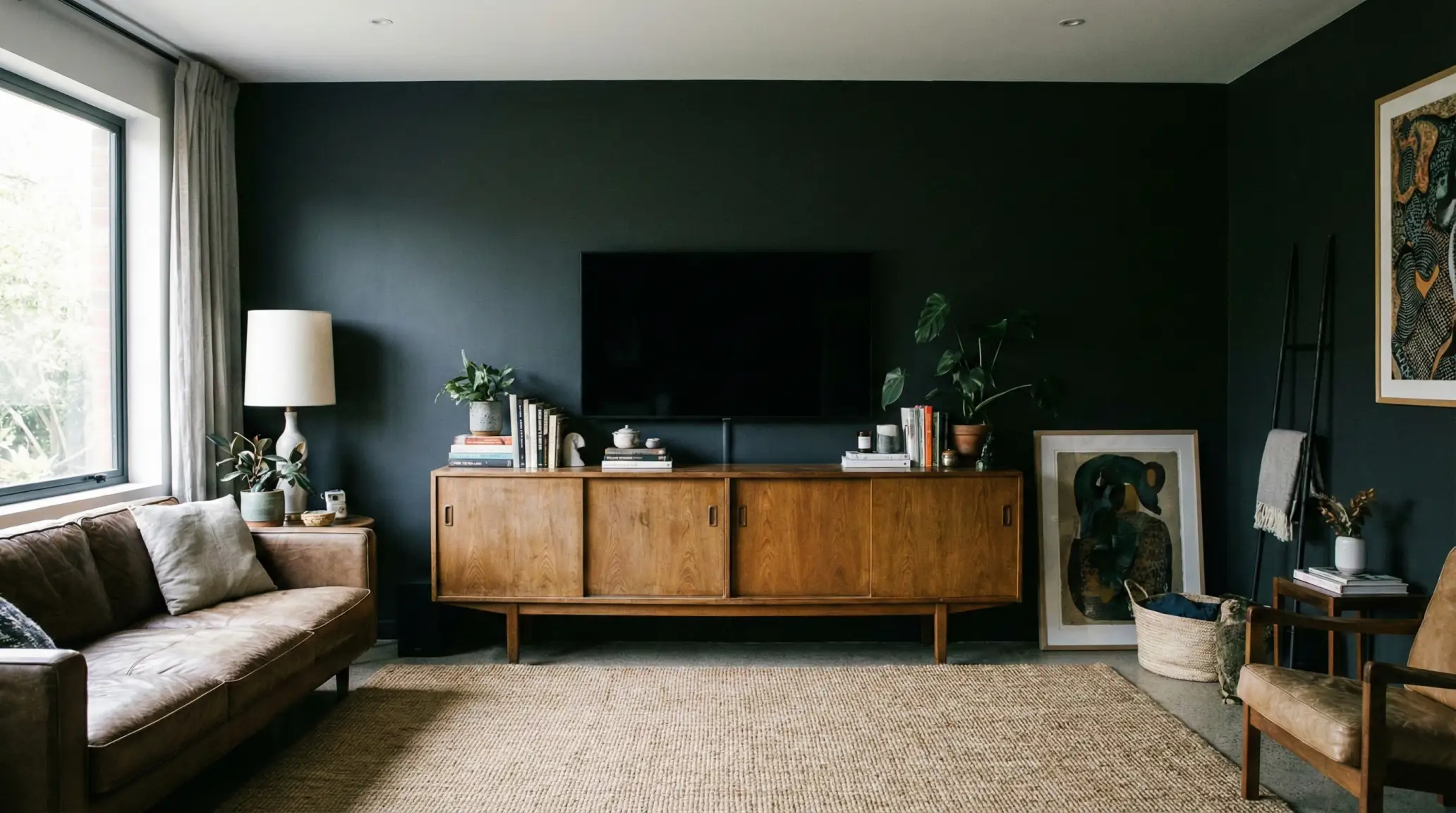
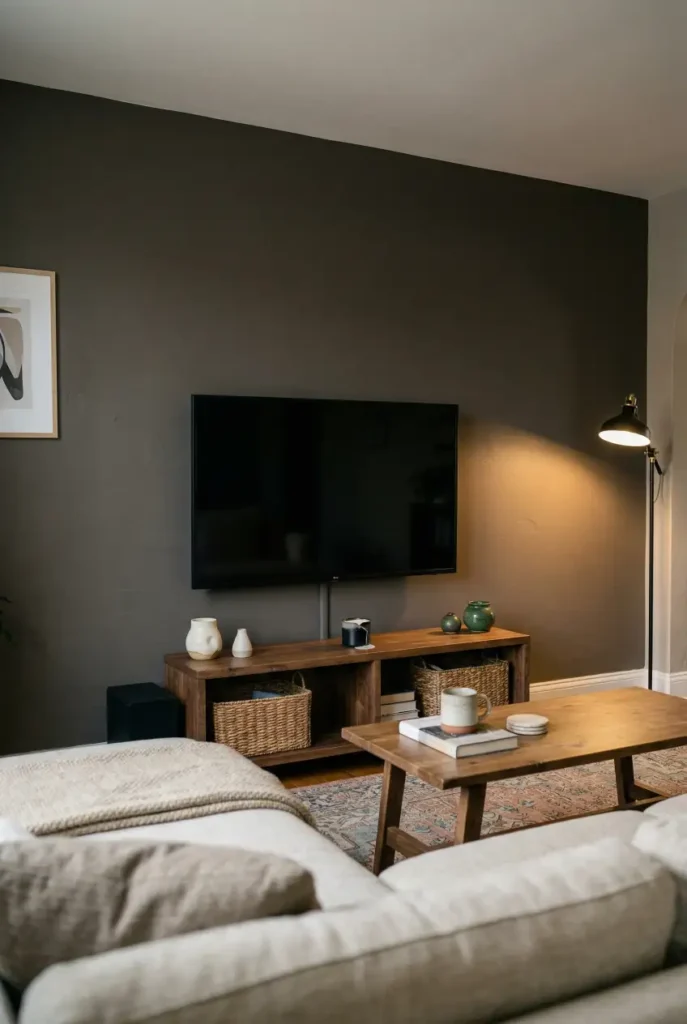
A clean, painted wall with nothing above the TV works when the wall itself is doing something. Builder white above a TV looks unfinished, full stop. However, a wall painted in deep charcoal, warm slate, or a considered earth tone? That empty space becomes a design decision, not an oversight.
The color is the decor. And sometimes that’s enough.
For a closer look at how the right paint color behind the TV changes the entire feel of the wall, the guide on the most common TV wall mistakes covers exactly that.
The TV Over the Fireplace: A Separate Problem
This situation deserves its own section, because the rules change.
Most TV-over-fireplace setups share the same flaw: the TV ends up at eye level when standing, which means neck strain when seated. On top of that, the space above the TV in this configuration is often 12 to 18 inches before the ceiling line. That’s a lot of unresolved wall.
Here’s the honest answer: when the TV is over a fireplace, it’s already competing with the surround as a visual element. Adding art or a shelf above it creates a third competing focal point. That’s too many things asking for attention in one spot.
In this case, focus on the sides rather than above. Flanking the TV with tall, slender objects at mantel level, such as a pair of candlesticks or a tall vase on each side, pulls the eye horizontally and makes the whole setup feel grounded. That’s the fix for over-fireplace TVs. Not what goes above. What goes beside.
The One Mistake That Undermines All of It
Regardless of which option you choose, one mistake will quietly ruin the result.
Going too small.
A tiny piece of art. A narrow shelf overloaded with miniature objects. A single plant in a 3-inch pot. From the sofa, those things disappear. They don’t read as intentional decor. Instead, they read as things placed there temporarily and then forgotten.
So scale up. Whatever your instinct says, go one size larger. The vase you think is a bit much is usually exactly right from twelve feet away. The art you almost bought but thought was too big is usually the right art. Real rooms, viewed from real distances, need objects with real presence.
That gap between the rooms that photograph well and the ones that feel right when you’re actually sitting in them? It’s almost always scale.
For more on how the entire TV wall comes together, including the wall treatment itself, the full ECH- covers every part of it.
Frequently Asked Questions
The art should be 50 to 75 percent of the TV’s width. For a 65-inch TV, that means a piece roughly 32 to 49 inches wide. Also, leave 6 to 8 inches of wall between the top of the screen and the bottom of the frame. Anything smaller reads as an afterthought from the sofa.
Yes, as long as you use proper wall anchors and patch on the way out. Most landlords allow standard wall holes for shelving, so a single floating shelf with two mounting points is one of the easier rental-friendly upgrades you can make. Use a level, locate the studs first, and the patch on exit takes about ten minutes.
Completely. However, the condition is that the wall itself has to be doing something. Builder white above a TV looks unfinished. A considered paint color or a strong wall treatment, on the other hand, makes an empty wall above the TV feel like a deliberate choice rather than an oversight.
About 6 to 10 inches above the top edge of the screen. Close enough to feel connected to the setup, but far enough that the objects on the shelf don’t visually merge with the TV. If the shelf is too high, it disconnects from the screen and reads as a random floating shelf instead of a styled composition.
Center it with the TV, not the wall. The screen is the anchor point, so art centered on a wider wall but off-center with the TV will look misaligned. The only exception is when the TV is positioned very far to one side of the wall. In that case, use your eye rather than a ruler, because strict centering with the screen can sometimes look just as awkward.