The pantry looked like a magazine spread when I finished. Matching containers, printed labels, everything decanted and arranged by category, color, and frequency of use. I even took photos. This was my attempt at realistic pantry organization, done properly, once and for all.
Eleven days later it was chaos again.
Not because I stopped caring. Because the system was designed for a photoshoot, not for a Tuesday morning when you’re making lunches before school and you just need to find the peanut butter.
Why Pinterest Pantry Organization Always Fails
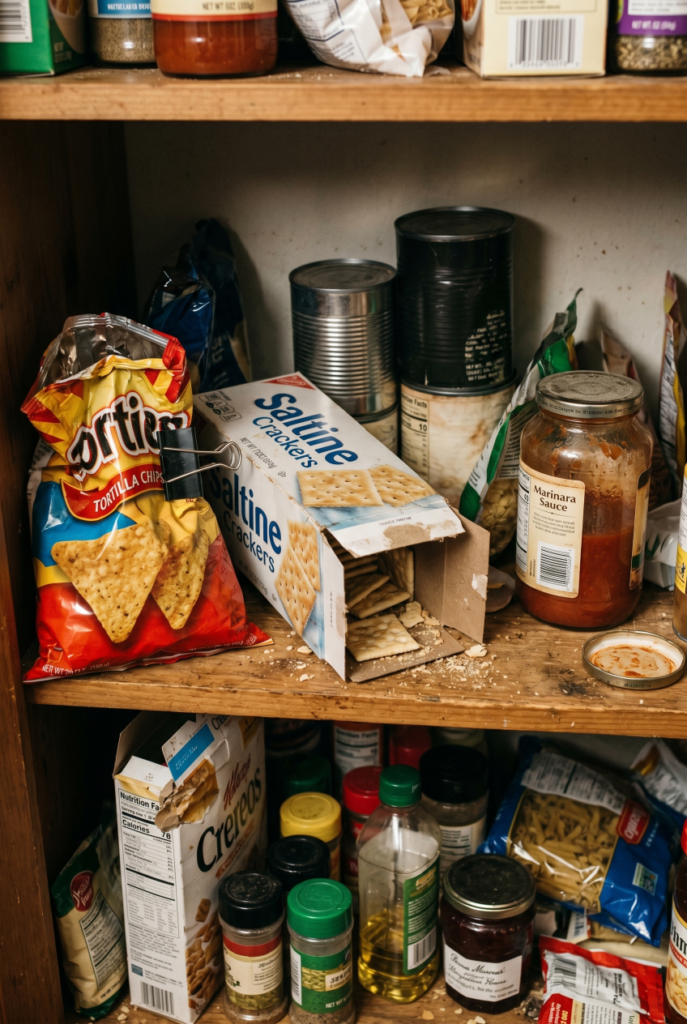
The photos are real. The systems in them are not. Realistic pantry organization looks nothing like what you see on Pinterest.
What you’re looking at when you see a perfect pantry on Pinterest is a space that was organized once, photographed, and never used again at full speed. Every jar matching, every label facing forward, every inch of shelf space accounted for.
Real kitchens don’t work like that. Real kitchens have a half-empty bag of tortilla chips that doesn’t fit in any container. A can of something you bought for a recipe two years ago. Three different types of olive oil because you keep forgetting you already have one.
The mistake isn’t buying the wrong containers. The mistake is building a system that requires maintenance discipline you don’t actually have on a Wednesday night.
I’ve organized my pantry four times in the last six years. The version that’s lasted is the one that looks the least impressive in photos. And it’s the only one worth telling you about.
The Real Problem With Most Pantry Advice
Most guides tell you to start by buying containers.
Wrong order. Completely wrong order.
You buy containers before you understand what you’re actually storing and how often you reach for it. So you end up with beautiful matching bins that hold the things you use once a month, and the things you use every day are still in their original packaging because they don’t fit the system.
Before anything else, spend ten minutes pulling everything out of your pantry and sorting it into two piles. Daily use. Everything else.
Daily use is: whatever you reach for more than twice a week. Coffee, cooking oil, the grains or pasta you make regularly, the snacks your household actually eats, the condiments that live on the counter half the time anyway.
Everything else is: the baking supplies you use at Christmas, the specialty ingredients for that one dish, the canned goods that are there for emergencies. These things need storage. They don’t need a system.
This is the part no one talks about. Most pantry organization advice treats every item the same. It doesn’t. The things you use every day need to be effortless to reach and effortless to put back. Everything else just needs a shelf.
The System That Has Lasted More Than a Year
Three zones. That’s the foundation of realistic pantry organization. Not aesthetics. Behavior.
Zone 1: The reach zone. Eye level and one shelf above and below it. This is where everything you use daily lives. No containers required if you don’t want them. The rule is just: if you use it more than twice a week, it goes here. Always.
Zone 2: The weekly zone. Upper shelves and lower shelves. Things you use regularly but not daily. Baking staples, pasta shapes you rotate through, canned goods you actually cook with. These benefit from containers because you’re reaching for them often enough that decanting makes sense.
Zone 3: The storage zone. The back of shelves, the high shelves, the floor space if you have a walk-in. Bulk items. Emergency supplies. The things that don’t need to be easy to reach because you rarely reach for them.
The reason this lasts is because it’s organized around behavior, not aesthetics. You don’t have to think about where something goes. Daily things go in the reach zone. That’s the whole rule.
Where Containers Actually Help (And Where They Don’t)
Honest answer: containers help in about half your pantry. Not all of it.
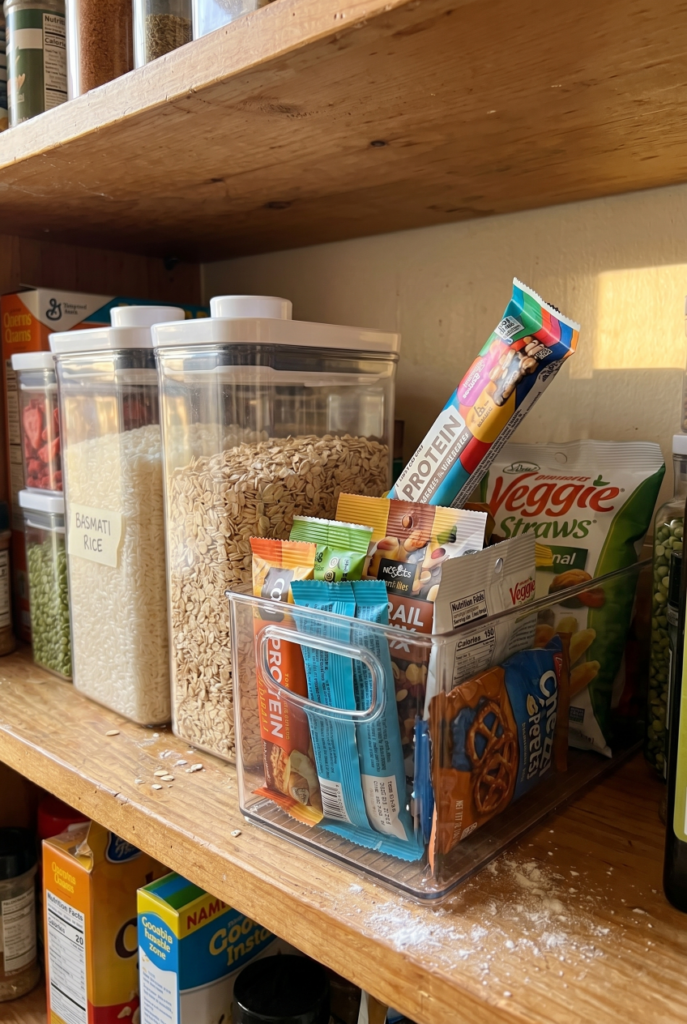
They help when you’re storing dry goods you use regularly: flour, sugar, rice, oats, pasta, coffee beans. Decanting these into airtight containers keeps them fresher, makes it faster to see how much you have left, and stops the half-open bags that spill every time you move them.
They do not help for: canned goods, boxed items with their own packaging, things you buy in bulk but use slowly, anything with a short shelf life that you go through before it could possibly go stale.
The mistake I made on my first three attempts was decanting everything. Opening a brand new bag of pasta and pouring it into a container when the bag was going to be empty in a week anyway. That’s not organization. That’s just extra dishes to wash.
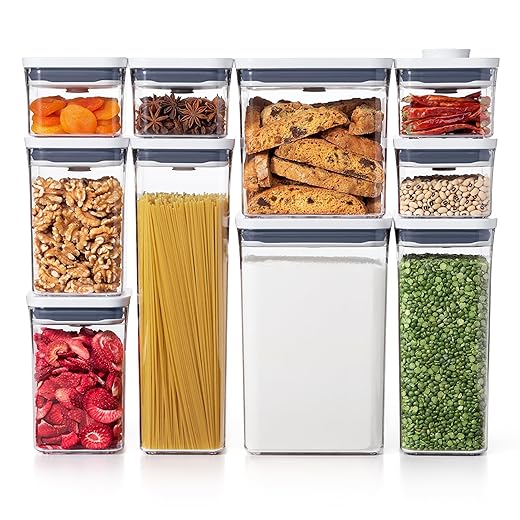
After years of testing I’ve landed on OXO Good Grips POP containers for the things that genuinely benefit from them. The airtight seal is real, not just a marketing claim. The square shape means they stack and line up without wasted space. And the push-button top means you can open them with one hand while holding a pot with the other.
They’re not the cheapest option. But I’ve had mine for four years and they look exactly the same as when I bought them. I’ve replaced cheaper containers twice in that same time. The math works out.
For the weekly zone, the mDesign stackable bins with handles are what I use for categories that don’t need airtight storage: snack bags, packets, the miscellaneous things that don’t fit in a container but need a home. The handle is the key detail. You pull the whole bin out to find what’s in it, which is faster than moving things around on a shelf.
The Products Worth Buying (And Which One to Skip)
I’m going to be direct about this because most pantry organization content won’t be.
You do not need to buy a full matching set of everything before you start. That’s the trap. You buy 24 containers and then spend a month organizing before you ever use the system, and then the system never gets tested in real life before you’ve committed to it.
Buy what you need for Zone 1 first. Use it for two weeks. Then buy for Zone 2. That’s the order.
Here are the three things worth spending money on, ranked by how much difference they make:


The criteria that matter for each: how long it holds up with daily use, whether it actually keeps food fresh or just looks like it does, and whether you’ll still be happy with it in two years when the novelty has worn off.
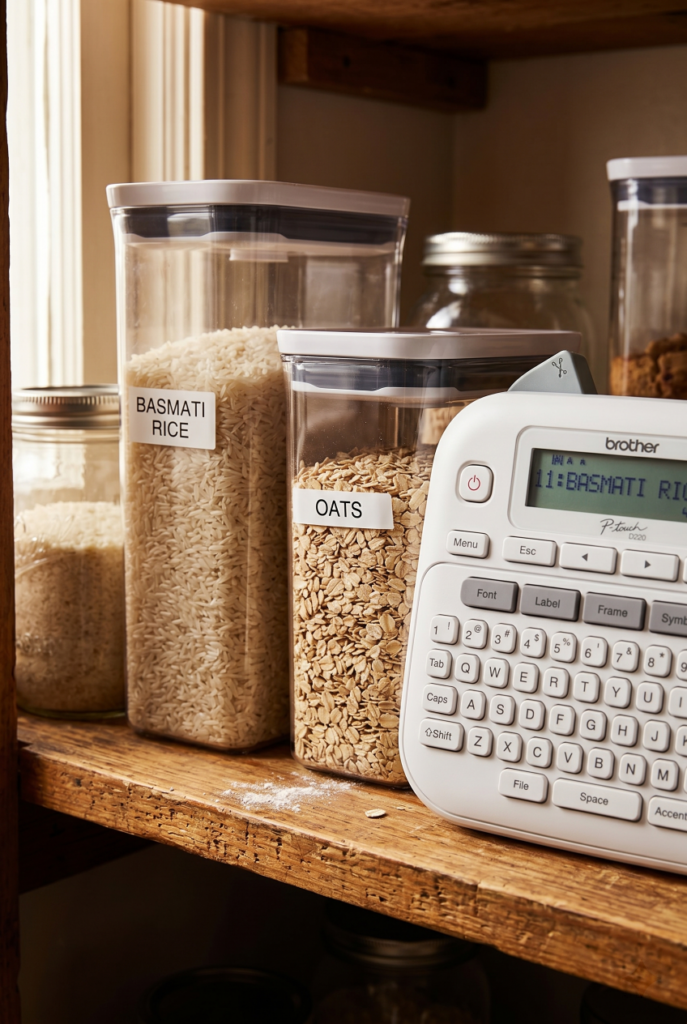
The OXO containers earn their price. The mDesign bins are genuinely good and reasonably priced. The Brother label maker sounds like a luxury until you’ve spent three minutes squinting at unlabeled white containers trying to figure out if it’s powdered sugar or cornstarch.
I’m not going to tell you to skip the label maker. I used to think it was unnecessary. Now I use it for everything.
What Maintenance Looks Like in Real Life
This is the section that will save your realistic pantry organization from collapsing in six months.
The system fails when restocking becomes a separate task from using. If putting groceries away requires you to first decant things into containers before anything can go back in its place, you will stop doing it within a month.
The fix is unglamorous: keep a small stack of decanted containers near the pantry, not inside it. When you unpack groceries, you decant into the containers as you put them away. One motion, not two separate tasks.
The second thing that kills pantry systems is the back-of-shelf problem. Things get pushed to the back and forgotten. Every two weeks, when you do your grocery shop, pull everything forward before you put new things in. New stuff goes behind old stuff. Takes thirty seconds. Prevents the mystery cans.
That’s the whole maintenance system. Two habits, not twelve.
The Pantry Audit That Makes This Easier
Before you buy a single container, do this once.
Pull everything out. Check dates on anything you’re not sure about. Throw away what’s expired. Put back only what your household actually eats.
This sounds obvious. It isn’t, because most people skip it and try to organize around the things they should throw away. You cannot build realistic pantry organization on top of things you don’t use. The clutter isn’t organizational failure. It’s stuff that shouldn’t be there.
Most people who do this find their pantry is about 30 percent smaller than they thought. That changes what you need to buy. Most of the time, you need less than you think.
I did this last spring after we’d had the same pantry for four years without ever doing a full clear-out. I threw away eleven things. Eleven. Some of them from 2023. The pantry felt twice as big afterward and I hadn’t bought a single container yet.
Start there. Everything else is easier after.
For Small Pantries and Rental Kitchens
If you have a small pantry, a single cabinet, or a rented space where you can’t add shelves, the zone system still applies. You just compress it.
One shelf or one section of a cabinet is your reach zone. The things you use every day live there, grouped by when you use them. Breakfast things together. Cooking staples together. Snacks together.
The back of that same shelf or the shelf above it is your weekly zone. That’s where you store the things you reach for regularly but not daily.
Over-the-door organizers are the single biggest return on investment for small pantries. One mounted on the inside of a cabinet door adds a full shelf’s worth of storage without taking any floor or shelf space. Use it for spices, small packets, things that get lost in the back of shelves.
Free-standing wire shelving that you can take with you when you move is genuinely worth buying if you’re renting. It’s one of the few things you can take to the next place and have it work just as well.
The pantry organization advice that shows you adding a pull-out drawer system or custom built-in shelving is not for renters. None of it is. But the zone system and the containers work in any space. The principle doesn’t require square footage.
The 3 Products Worth Buying (And Why These Over Everything Else)
|
OXO Good Grips 10 Piece POP Container Set
|
mDesign Plastic Stackable Kitchen Organizer – Storage Bin with Handles for Refrigerator
|
Brother P-Touch PTD220 Home
|
|
|---|---|---|---|
|
|
|
|
|
| Best For | Dry goods you use daily: flour, sugar, rice, pasta, oats, coffee | Snacks, packets, loose items that don't need airtight storage | Anyone with more than 6 containers who wants to stop guessing what's inside |
| Price Range | $112.95 | $59.99 | $44.99 |
| Lasts How Long | 4 plus years with daily use. The seal and the button hold up. Mine still look new | 2 to 3 years with regular use. The plastic is solid, not brittle | Years. Label tape is the only thing you replace and it costs about $8 a roll |
| Worth It If… | You cook regularly and go through dry goods fast enough that freshness actually matters | Your pantry has a loose items problem: half-open bags, packets, things with no real home | You have kids, a shared kitchen, or anyone else who opens containers and doesn't know what's inside |
| Skip It If… | You barely cook and go through flour once a year. A cheaper airtight option works fine | Your shelves are too narrow for a bin to sit flat. Measure depth first: needs at least 11 inches | You have five containers or fewer. Handwritten labels on tape do the same job at zero cost |
| Check Price on Amazon | Check Price on Amazon | Check Price on Amazon |
The Questions I Get Every Time About Pantry Organization
Build the reset into the grocery routine, not as a separate task. Every time you put groceries away, pull existing items forward and put new ones behind. Decant as you unpack. That two-minute habit is what separates systems that last from systems that look good for three weeks and then collapse.
No. Matching containers make the pantry look calmer and more intentional, which has a real effect on how you feel about the space. But mismatched containers with a consistent labeling system work just as well functionally. Start with what you have, add matching containers gradually as things need replacing.
Turntables for canned goods and bottles at the back. Pull-out bins for packaged items so you can see everything without reaching. And a simple rule: nothing goes behind something else unless it’s the same category. Grouping by category means when you reach for pasta, you’re only moving pasta to find the shape you want.
Less than most guides suggest. If you already have some containers, a basic refresh costs $30 to $50: a set of airtight containers for dry goods, a few clear bins for loose items, and labels. A full pantry overhaul with quality containers runs $80 to $150 depending on pantry size. The expensive matching sets you see on Instagram are $200 plus and not necessary for a system that works.
Yes, and this is where the zone system is most useful. You’re working with fixed shelves you can’t modify, so the organization has to come from how you group things and what containers you use, not from the structure of the space itself. Over-the-door organizers and freestanding wire shelving are the two additions that make the biggest difference without touching any walls or permanent fixtures.