Every plant was healthy. Every pot was one I’d picked on purpose. And somehow my living room looked like the lobby of a mid-range dental office: a sad ficus by the window, a cactus on the windowsill, a trailing pothos on the bookshelf that nobody had asked to be there. Fourteen plants that had nothing to say to each other.
I spent a Saturday afternoon last spring doing what I usually do when a room bothers me: I started moving things around without a plan. I pulled the monstera away from the window. I grabbed the pothos off the bookshelf. I put them both in the corner by the couch, along with a terracotta succulent that had been sitting alone on the coffee table for eight months. Same plants. Same pots. And the corner suddenly looked like something I would save on Pinterest.
I stood there for a while trying to figure out what had changed. Nothing about the plants was different. What changed was that they were finally together, at different heights.
The thing nobody tells you about plants for home decor
We buy plants one at a time. We place them wherever there’s a flat surface. And then we wonder why the room doesn’t look like the photos we saved. The photos aren’t showing us one plant. They’re showing us a composition: plants at different heights, in pots that share a color temperature, with light hitting them from the side. The plant is almost incidental. What you’re responding to is the grouping.
Using plants for home decor effectively has nothing to do with the number of plants or the species. It’s about placing them in deliberate groups, varying in height and similar in pot tone, so the eye reads them as one designed moment rather than scattered objects.
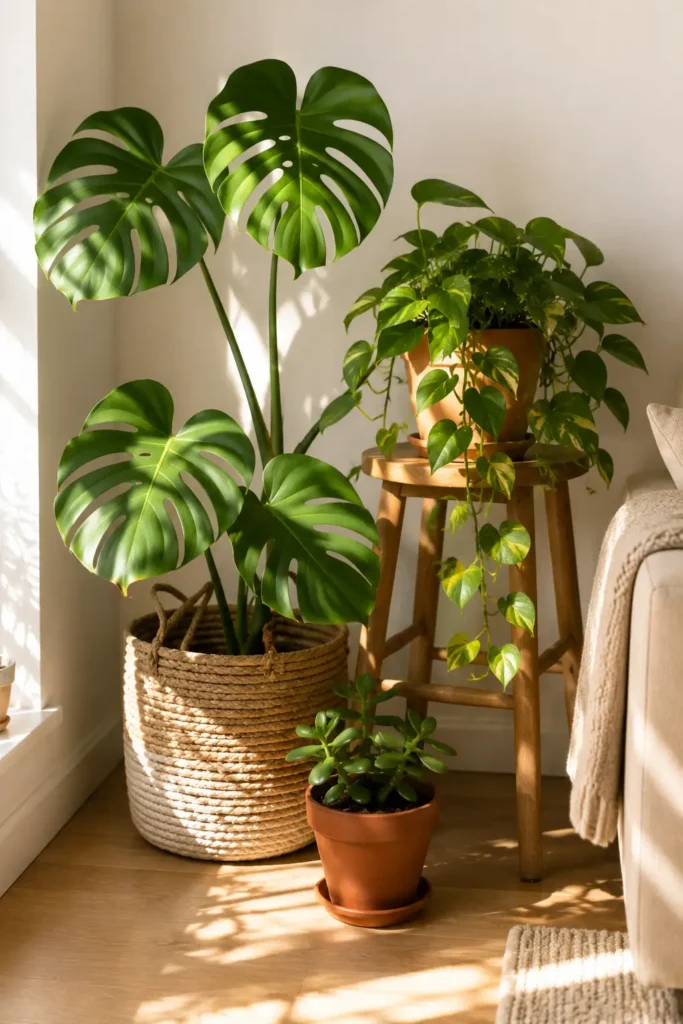
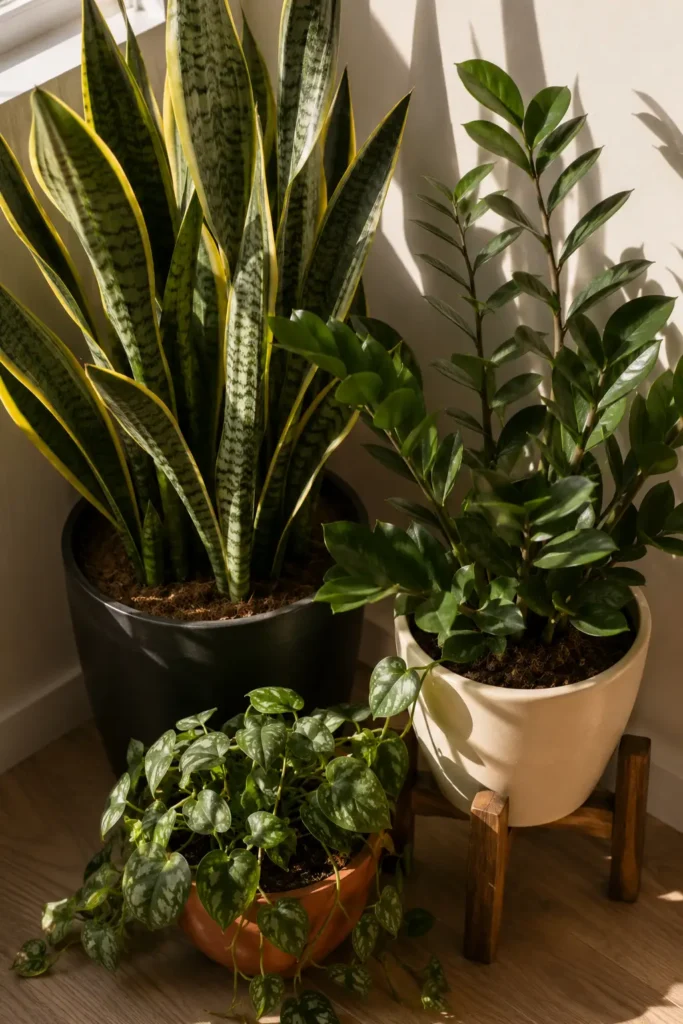
What I had done accidentally that Saturday was create a group. Monstera on the floor at about four feet. Pothos on a wooden plant shelf at around two feet. Succulent at the base, barely a foot off the ground. My eye moved through them like it was reading a sentence, bottom to top, and then rested. That’s what a designed corner feels like: the eye lands somewhere and stays.
What I did with the other eleven plants
I moved them out of the living room entirely. Some went to the bedroom, some to the kitchen windowsill where they made more practical sense, a few I gave away because I realized I’d bought them to fix a problem they were never going to fix. The living room ended up with three plants instead of nine, and it looked ten times better.
This is the hardest part to accept: more plants rarely solves a plant decor problem. Fewer plants, grouped better, almost always does.
The collected, lived-in look that works so well in interiors is not about having more objects. It’s about placing the objects you have with enough intention that they feel chosen. Plants respond to that principle exactly the same way furniture does.
The pot problem I ran into (and how I fixed it)
Once I had the grouping right, the pots started bothering me. The monstera was in a white ceramic. The pothos was in a plastic nursery pot inside a gray concrete-look cover. The succulent was in terracotta. Three different color temperatures (cool, cool-neutral, warm) and the group still looked restless even when the heights were right.
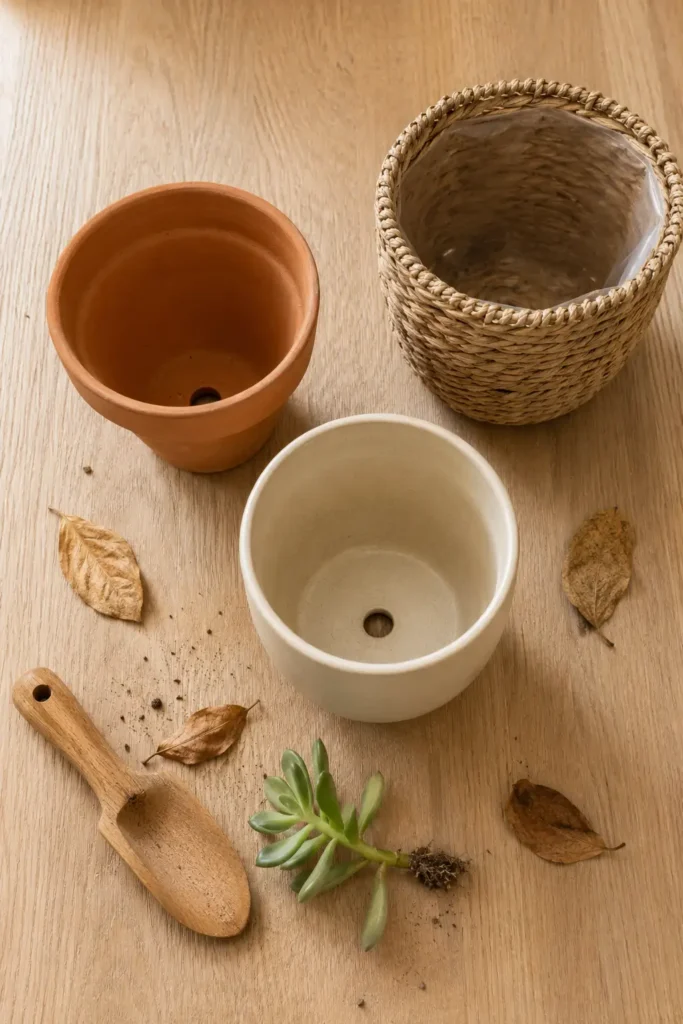
I swapped the monstera’s pot to a cream ceramic and replaced the gray cover with a woven basket liner. Now everything in the corner was warm-toned: terracotta, cream, woven natural fiber. They don’t match, but they belong to the same family, and that’s enough. The difference was immediate and I’m slightly embarrassed it took me this long to notice it.
The rule that actually works: pick warm tones (terracotta, cream, ochre, wood, brass) or cool tones (white, gray, black, dark green) for a grouping, then mix textures freely within that. Matching pots exactly looks staged; completely random looks chaotic. Shared color temperature is the middle ground that reads as designed.
Once the pots felt right, I noticed something else was still off.
The light thing I discovered by accident
About a week after I set up the corner, I noticed the plants looked flat in photos: nice in real life, dull on my phone. I rotated the whole arrangement about 90 degrees so the window hit it from the side instead of from behind me. Suddenly the monstera leaves showed depth (the large, split leaves respond especially well to side light), the shadows on the pothos looked sculptural, the whole corner had texture.
Side lighting is what makes plants look alive in photos. Front lighting (window behind the viewer) washes them out. If your plant corner looks flat when you photograph it, try rotating it before you try anything else.
I didn’t move any furniture. I just turned the stool 90 degrees and shifted the monstera a foot to the left. Two minutes, no tools, completely different corner.
A fast test for when your plants for home decor aren’t working
Stand at the entrance of the room. Look at where your plants are. Ask yourself: does my eye go to one spot, or does it split between three different surfaces?
If it splits, you have a grouping problem, not a plant problem. Before buying anything new, try consolidating what you own into one or two deliberate locations. A room with six plants in one corner and nothing elsewhere almost always looks better than the same six plants spread across every available surface.
That’s the version of maximalism that doesn’t tip into chaos: not fewer objects, just objects placed with enough intention that the eye knows where to go.
My apartment still has fourteen plants. I just stopped asking all of them to decorate the living room at the same time.